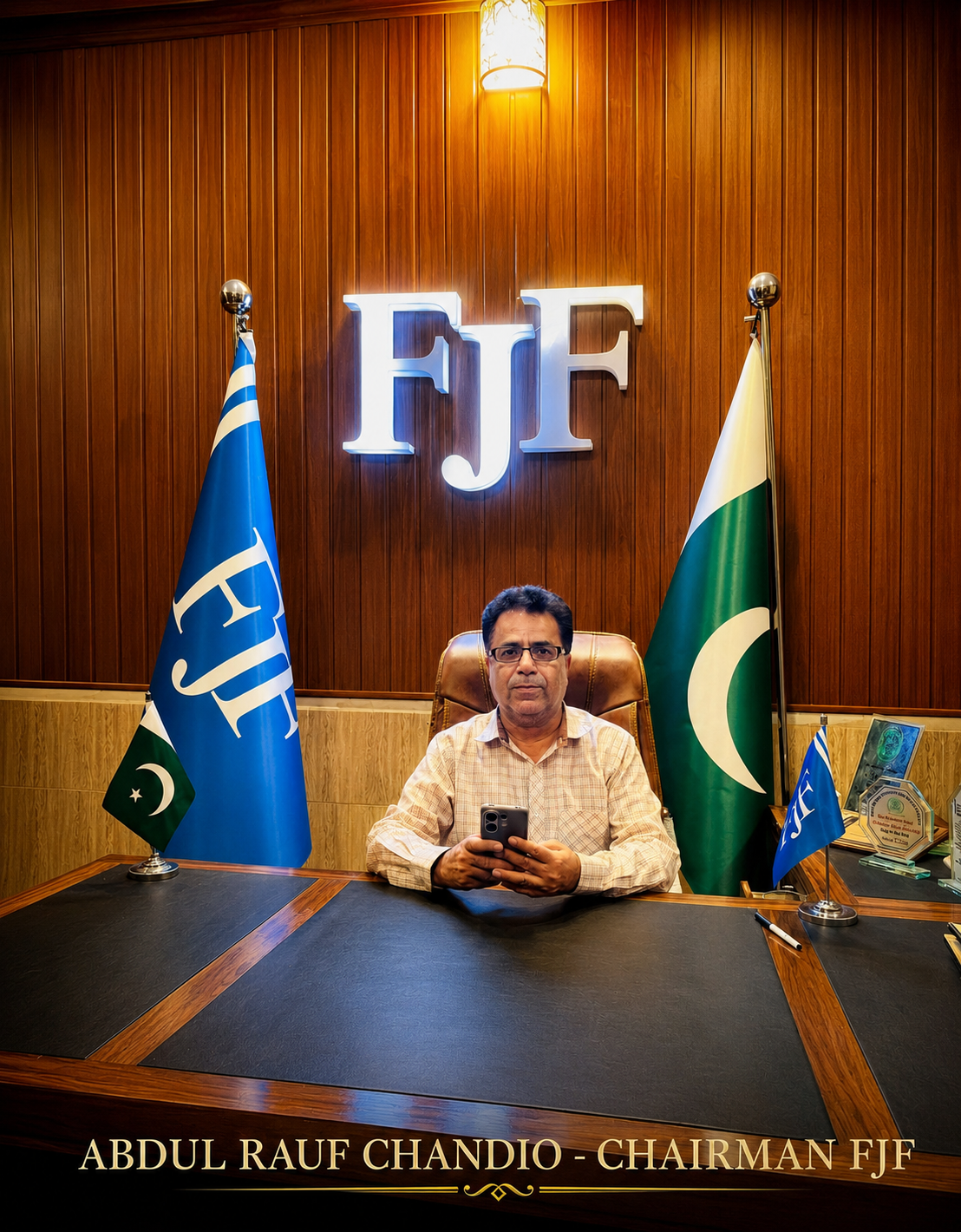
Abdul Rauf Chandio is a Hyderabad-based journalist, broadcast media director, and education-sector leader with more than 25 years of professional experience spanning print journalism, television broadcasting, and community development. He is the founder and Chairman of the Free Journalist Foundation (FJF), founded in 2008 and formally registered under the Societies Registration Act (Reg. No. 7318) on June 26, 2014 — a government-partnered education network operating across the Hyderabad, Jamshoro, and Mirpurkhas districts of Sindh.
At a Glance
| Full name | Abdul Rauf Chandio |
| Born | Bhanbho Khan Chandio, District Larkana |
| Current role | Chairman, Free Journalist Foundation |
| Media career | 25+ years (1995–present) |
| Education sector leadership | 13+ years (2015–present) |
| Education | M.A. Sociology, M.A. Mass Communication & Media Studies, LL.B — University of Sindh, Jamshoro |
| Organization | FJF founded 2008; registered under Societies Act (2014) |
Early Life
Abdul Rauf Chandio was born on February 1, 1978, in the village of Bhanbho Khan Chandio, District Larkana — a rural setting where access to quality schooling, healthcare, and civic infrastructure was, and in many pockets still is, limited. Growing up in this environment gave him a first-hand understanding of what it means for a family to be shut out of opportunity simply because of geography or income. That early exposure is the thread that runs through his entire career: first as a reporter documenting the gap between policy and reality in rural Sindh, and later as an institution-builder trying to close that gap directly through education.
He completed his Matriculation at Govt. High School Bhambho Khan in 1993 and his Intermediate at Shah Latif College, Kamber, in 1995 — the same year he entered journalism professionally, balancing early-career reporting with continued academic study over the following two decades.
Journalism Career
Mr. Chandio entered journalism in 1995 as a field reporter for Daily Kawish, at the time and still today Sindh’s largest-circulation Sindhi-language newspaper. Field reporting in the mid-1990s meant direct, on-the-ground coverage of local governance, crime, agriculture, and rural development — beat experience that shaped his editorial instincts for the rest of his career.
Over the following decade he moved through a series of senior editorial roles at regional Sindhi-language publications:
- Sub-Editor, Daily Halchul, Hyderabad
- Sub-Editor, Daily Sindh, Hyderabad
- Chief Reporter, Daily Sham, Hyderabad
- Bureau Chief, Daily Tameer Sindh, Karachi (Hyderabad bureau)
- Bureau Chief, Daily Khabroon, Karachi (Hyderabad bureau)
Alongside these staff roles, he filed freelance features and policy-oriented reporting for the Sunday edition of The News International, one of Pakistan’s largest English-language dailies — work that carried Sindh-focused stories on governance, rural development, and social issues into national English-language discourse, well beyond the reach of regional-language press.
In 2005, he transitioned into broadcast journalism as Bureau Chief at Sindh TV, Hyderabad, a role he held for roughly three years. In 2008, he joined Mehran TV as Director News & Current Affairs, a position he held for 13 years until his resignation in 2021. This was the longest and most influential chapter of his media career: as Director News, he was responsible for newsroom operations, editorial direction, and the creation of Mehran TV’s flagship current-affairs programming, including:
- Stand Point — a live political debate program on governance and public accountability
- Sidhi Galh — daily current-affairs and policy discussion
- Sindh Speaks — coverage of Sindh’s political identity and provincial policy issues
- Career Counselling — career guidance programming aimed at Sindh’s youth
- Education Metro — advocacy-focused programming on education reform and school development
- Binat-e-Hawa — a program spotlighting women’s rights, struggles, and achievements in Sindh
- Mehran Reports — an investigative documentary series covering corruption and governance failures
Beyond the programming itself, his 13 years at Mehran TV functioned as a training ground: a number of journalists who worked under him in the newsroom have since gone on to build independent careers across Sindh’s regional television and print media.
Development Sector Experience
Before his broadcast career took off, Mr. Chandio spent roughly a year, from February 2004 to March 2005, as Information, Education & Communication (IEC) Officer at the Sindh Irrigation & Drainage Authority (SIDA). In this role he:
- Designed and implemented public-awareness and communication campaigns on water management and irrigation
- Conducted opinion surveys to gauge stakeholder awareness of SIDA-related issues at multiple levels
- Developed messaging linking water and irrigation policy to farmer livelihoods, and built this into SIDA’s broader outreach strategy
- Produced and distributed SIDA’s quarterly newsletter/bulletin covering the authority’s activities
This period is easy to overlook next to his media career, but it is directly relevant to his later work: it was his first experience designing structured, government-linked outreach programs for rural communities — the same operating model FJF would later use to deliver education services in partnership with a government foundation.
Academic Background
Mr. Chandio’s academic record reflects sustained study alongside a full-time career:
- Matriculation, Govt. High School Bhambho Khan (1993)
- Intermediate, Shah Latif College, Kamber (1995)
- B.A., University of Sindh, Jamshoro (2000)
- M.A. Sociology, University of Sindh, Jamshoro (2003)
- B.Ed, Shah Abdul Latif University, Khairpur (2007)
- M.A. Mass Communication & Media Studies, University of Sindh, Jamshoro (2014, First Division)
- LL.B, University of Sindh, Jamshoro (2016, First Division)
Taken together, this is an unusually broad academic base for someone in his field: sociology gives him a formal grounding in social structure and rural inequality, the B.Ed and later media degree map directly onto his two operating careers (education and broadcasting), and the LL.B gives him working knowledge of the legal and regulatory environment that governs both media operations and the registration, compliance, and contractual obligations of an organization like FJF. Few people running a multi-district education program in Sindh combine all three credentials.
Free Journalist Foundation — Founding and Leadership
Mr. Chandio founded the Free Journalist Foundation in 2008, and formally registered it under the Societies Registration Act on June 26, 2014. In its early years, he ran Zakia Model School as a charitable school, funded independently, before FJF had any government backing.
That changed in 2017, when FJF entered a formal delivery partnership with the Sindh Education Foundation, Government of Sindh — a partnership that remains FJF’s primary institutional relationship today, and the mechanism through which most of its schools and learning centres are funded and monitored.
Under his chairmanship, FJF has grown from a single charity school into a structured, multi-district organization:
| Head Office | Zakia Model School, New Karan Khan Shoro, Jamshoro Road, Qasimabad, Hyderabad |
| Districts of operation | Hyderabad (HQ), Jamshoro, Mirpurkhas |
| Formal schools | 6 |
| Community-based NFE (Non-Formal Education) centres | 20 |
| AALTP (Accelerated Learning & Training Program) centres | 2 |
| Children served | Approx. 5,000 |
| Staff | 150 |
| Institutional partners | Sindh Education Foundation; Directorate of Literacy & Non-Formal Education (Government of Sindh) |
FJF-run schools include Zakia Model School (Qasimabad), Mehran Model School (Kotri), Sindh Public School (Khanpur, Kotri), and Zarina Model School (Kotri) — each delivering free tuition, books, and uniforms to enrolled students.
Across his time leading FJF, Mr. Chandio has accumulated 7 years of experience in Non-Formal Education, 13 years in Formal Education, and 16 years in skill development and on-the-job training — spread across FJF’s schools, community learning centres, and AALTP programs. This breadth of experience — running both formal schools and non-formal/accelerated learning programs simultaneously — is part of what has allowed FJF to serve out-of-school children as well as those in conventional classrooms.
Key Events and Achievements as Chairman
FJF’s public programming under Mr. Chandio’s chairmanship spans media outreach, youth development, and government-funded recognition events:
| Event | Date | Location | Detail |
|---|---|---|---|
| Sindh Media Conference | 11 January 2016 | Hyderabad Press Club | FJF-organized conference with panel discussions on media and society |
| Youth Workshop | 6 November 2016 | Hyderabad Club | Certificate distribution to youth participants |
| Girls’ Role in Culture Promotion & Challenges | 10 December 2017 | Hyderabad Club | Panel discussion with award/certificate distribution to female participants |
| Digital Socialization of Girls Youth & Role Model Youth Girls Awards | 2022 | Hyderabad | Delivered with a PKR 500,000 grant-in-aid from the Government of Sindh, Directorate of Youth Affairs |
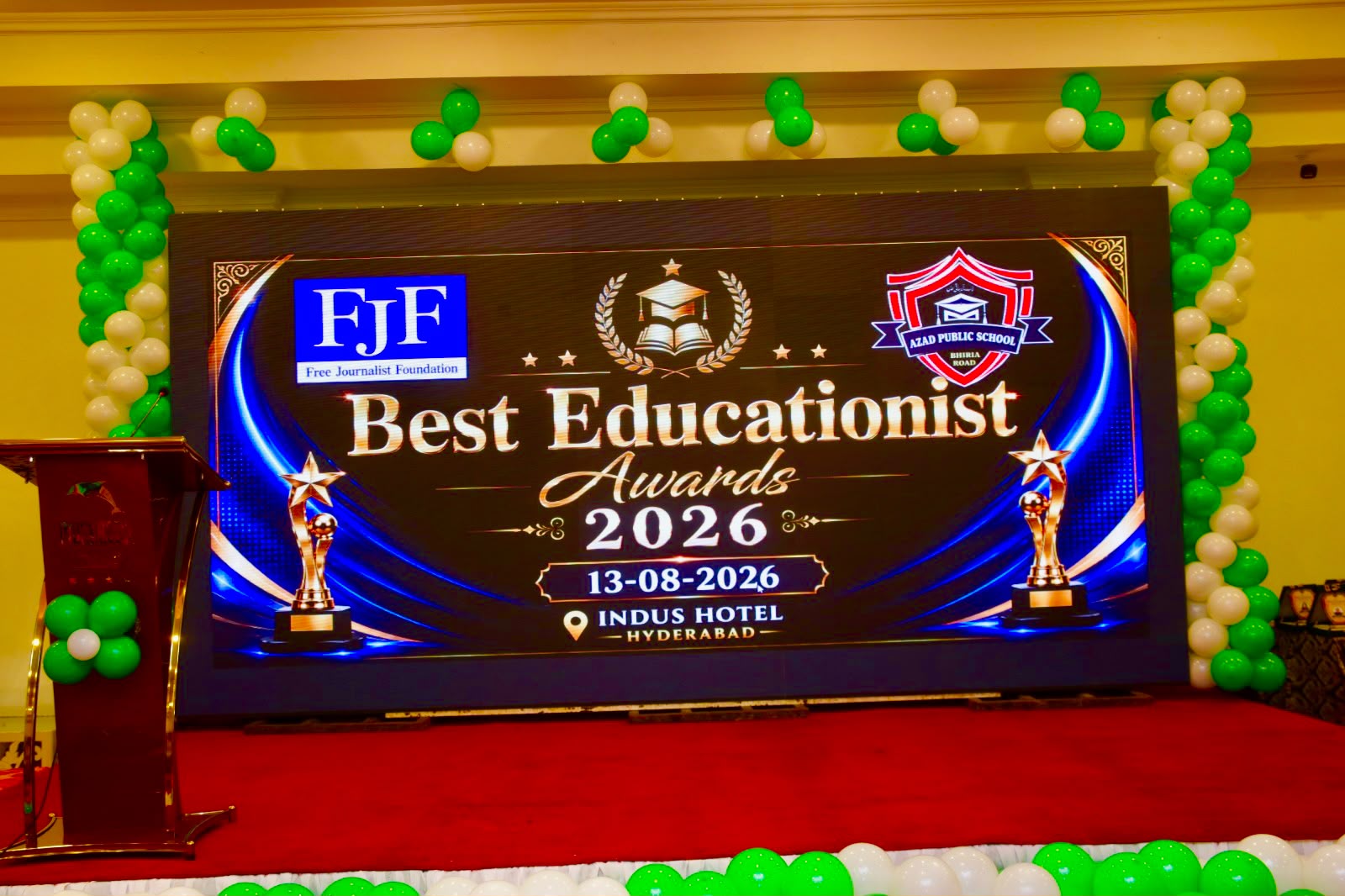
| Role Model Youth Girls Award 2023 | 20 December 2023 | Indus Hotel, Hyderabad | Delivered with a PKR 200,000 grant-in-aid from the Directorate of Youth Affairs |
| Performance Awards 2024 (for CCE batch 2020) | 2024 | Hotel Indus | Recognition event for FJF program outcomes |
| Independence Day Cultural Evening | August 2024 | — | Cultural event addressed by the Chairman |
| International Women’s Day — Role Model Awards | March 2025 | — | Award plaques presented to women recognized for community contribution |
| International Youth Day 2025 | 26 August 2025 | Karachi | Backed by a PKR 1,200,000 grant from the Directorate of Youth Affairs, Government of Sindh |
Beyond these documented events, FJF has held many more award ceremonies, exhibitions, and educational events over the years — too numerous to list individually. A recurring feature of these ceremonies is FJF’s practice of inviting senior public figures to address and motivate award recipients and students in person, including city commissioners and mayors, the Chairman of the Sindh Public Service Commission (SPSC), directors and managing directors of public and private institutions, and senior police officers such as District SSPs. Their presence at FJF ceremonies is intended to inspire awardees and reinforce the value of education and civic achievement in front of the wider community.
FJF has also institutionalized several of these events into recurring annual programs rather than one-off activities, including the Role Model Awards, Teacher Appreciation Ceremonies, and Youth Leadership Forums.
Public Roles and Affiliations
- Chairman, Free Journalist Foundation
- General Secretary, Hyderabad Press Club (2018)
- Member, Hyderabad Union of Journalists
- Former General Secretary, Hyderabad Sports Club
Philosophy
Mr. Chandio has repeatedly framed FJF’s work not as charity but as an obligation:
“Education is not charity — it’s a right. If we fail to deliver it to every child, we fail as a society.” — Abdul Rauf Chandio
Frequently Asked Questions
Who is Abdul Rauf Chandio? Abdul Rauf Chandio is a Sindh-based journalist with over 25 years in print and broadcast media, and the founder and Chairman of the Free Journalist Foundation (FJF), an education network operating in partnership with the Sindh Education Foundation, Government of Sindh.
What is the Free Journalist Foundation (FJF)? FJF is a registered organization that runs 6 formal schools, 20 community-based learning centres, and 2 AALTP centres across Hyderabad, Jamshoro, and Mirpurkhas, serving approximately 5,000 children with free tuition, books, and uniforms.
What was Abdul Rauf Chandio’s role at Mehran TV? He served as Director News & Current Affairs at Mehran TV from 2008 to 2021, overseeing newsroom operations and hosting or directing programs including Stand Point, Sidhi Galh, Sindh Speaks, and the investigative series Mehran Reports.
What is Abdul Rauf Chandio’s educational background? He holds a B.A. (2000), an M.A. in Sociology (2003), a B.Ed (2007), an M.A. in Mass Communication & Media Studies (2014, First Division), and an LL.B (2016, First Division), all from the University of Sindh, Jamshoro (with the B.Ed from Shah Abdul Latif University, Khairpur).
How is FJF funded? FJF’s core school and centre operations are funded through its partnership with the Sindh Education Foundation, Government of Sindh. Specific youth-focused events and awards have also received direct grants-in-aid from the Government of Sindh’s Directorate of Youth Affairs.