
Free Journalist Foundation (FJF) is a Hyderabad-based institution built around three core pillars: education, media literacy, and youth empowerment. Founded in 2008 and formally registered under the Societies Registration Act (Reg. No. 7318) on June 26, 2014, FJF has grown from a single school into a structured, government- partnered education network operating across Sindh. Today, FJF stands as one of the province’s more substantial community-education institutions — combining formal schooling, non-formal and accelerated learning programs, and structured youth and media-literacy training under a single, accountable institutional framework.
What sets FJF apart is not just the scale of what it runs, but the discipline behind how it runs it. Every school, learning centre, and program under FJF operates within a structured system of enrolment records, attendance tracking, facilitator training, and performance monitoring — the same standards of accountability that have made FJF a trusted delivery partner for provincial government departments in Sindh’s education and youth sectors.
Our History
FJF’s foundation was laid at Zakia Model School, the institution’s first school and the base from which its education network would later expand. In the years that followed, FJF steadily built out its academic and operational capacity — developing institutional policies, financial systems, and staffing structures capable of supporting more than one school and more than one type of learning program at once.
In 2017, FJF entered a formal delivery partnership with the Sindh Education Foundation (SEF), Government of Sindh — a partnership that remains FJF’s primary institutional relationship today, and the mechanism through which its schools and learning centres are funded and monitored under provincial oversight. This partnership marked a turning point: FJF moved from operating independently to operating as a recognized, government-aligned delivery partner, subject to the reporting, compliance, and quality standards that come with that role. Since then, FJF has expanded steadily into a multi-district education and youth-development network, backed by sustained, government-recognized institutional credibility built up over more than 15 years.
Where We Work
- Head Office: Zakia Model School, New Karan Khan Shoro, Jamshoro Road, Qasimabad, Hyderabad
- Districts of operation: Hyderabad, Jamshoro
FJF’s presence in these districts is not limited to a single campus or office — it is built out across multiple schools and dozens of community-based learning centres, each embedded directly in the communities they serve.
Our Educational Network
FJF operates a three-tier education network, designed to reach children through more than one pathway into learning:
- 6 formal schools — including Zakia Model School (Qasimabad), Mehran Model School (Kotri), Sindh Public School (Khanpur, Kotri), and Zarina Model School (Kotri) — delivering a full, structured academic curriculum from primary through secondary levels.
- 20 community-based Non-Formal Education (NFE) centres — smaller, community-embedded learning spaces designed for children who are out of school, offering flexible timings and an accelerated curriculum suited to their needs.
- 2 Accelerated Learning and Alternative Learning Programme (AALTP) centres — a specialized pathway for older out-of-school children and adolescents to catch up on foundational literacy, numeracy, and life skills before transitioning into formal education or vocational training.
Together, this network delivers structured education to approximately 5,000 children, with a strong focus on academic excellence, critical thinking, and skill development. FJF’s institutions are supported by a dedicated team of 150 staff — including school administrators, subject teachers, trained facilitators, monitoring and evaluation officers, accountants, and community mobilizers — and the organization operates in close, ongoing partnership with the Sindh Education Foundation (SEF) and the Directorate of Literacy and Non-Formal Education (DL&NFE), Government of Sindh — placing FJF among a select group of institutions trusted to deliver education at scale in partnership with the provincial government.
How We Work
FJF’s approach to education is deliberately structured, not informal. Every centre and school follows a consistent operating model built around:
- Community engagement and enrolment verification — working directly with local communities, parents, and committees to identify children in need of schooling and formally verify and record their enrolment.
- Locally recruited, trained facilitators and teachers — staff drawn from and embedded within the communities they serve, supported by structured induction, coaching, and ongoing professional development.
- Structured curriculum and learner-centred teaching — differentiated, activity-based instruction appropriate to each learner’s age and prior learning level, particularly within non-formal and accelerated-learning settings.
- Attendance and progress monitoring — regular tracking of enrolment, attendance, and learning outcomes, consolidated and reviewed on an ongoing basis to identify and address gaps early.
- Community ownership — local committees involved in supporting each school or centre with enrolment, attendance, and day-to-day problem-solving.
- Structured transition pathways — learners in non-formal and accelerated programs are supported toward formal schooling or further learning, rather than left without a next step once a program cycle ends.
This combination of formal, non-formal, and accelerated-learning experience under one institutional roof is a key part of what distinguishes FJF from single-purpose schools — it allows the organization to serve children already inside the education system as well as those who have never had the opportunity to enter it.
Youth Empowerment & Media Literacy
Beyond formal schooling, FJF runs Adolescent & Adult Learning and Training Programs delivering professional skills, literacy education, and career training. Through these initiatives, FJF has trained over 10,000 young individuals in media, journalism, and vocational fields. As an institution rooted in journalism, FJF places particular emphasis on ethical media practice, working closely with media organizations, academic institutions, and journalists to deliver training programs, workshops, and seminars on press freedom, digital literacy, and responsible storytelling.
This media-literacy focus is not incidental — it is core to FJF’s identity and origin. Where many education-focused institutions concentrate solely on academics, FJF’s programming deliberately equips young people with the skills to engage critically with information, media, and public discourse — a distinction that runs through the organization’s public events, training sessions, and career-guidance programming for youth.
Achievements, Award Shows & Events
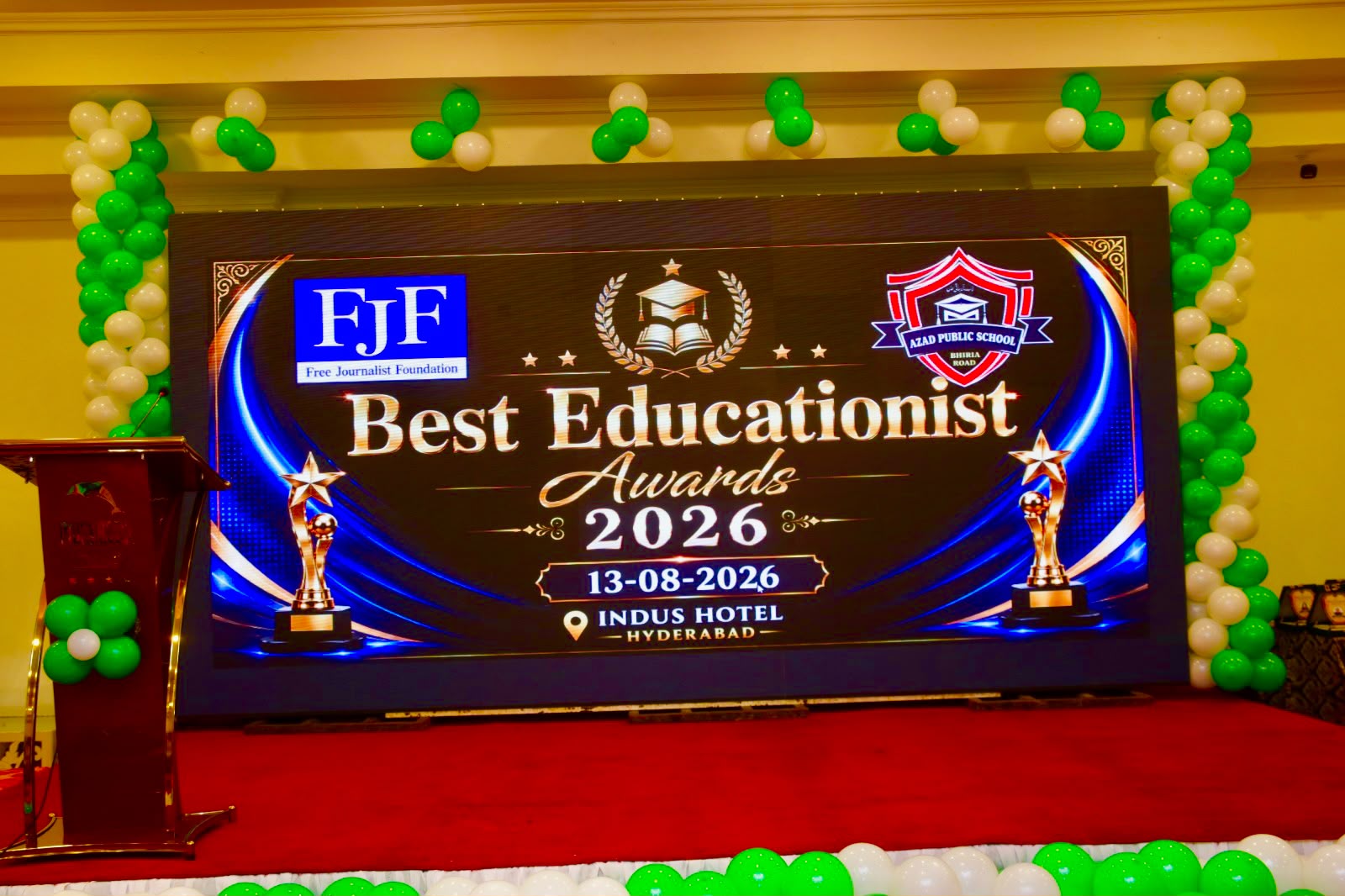
FJF has established itself as a leading convener of media, education, and youth-recognition events across Sindh, having organized and hosted a substantial and growing calendar of public events, including:
- Sindh Media Conference
- Youth Workshop
- Girls’ Role in Culture Promotion & Challenges
- Digital Socialization of Girls Youth & Role Model Youth Girls Awards
- Role Model Youth Girls Award
- Role Model Teacher Awards
- Performance Awards
- Independence Day Cultural Evening
- Independence Day Award Show
- International Women’s Day — Role Model Awards
- International Youth Day
These are among the many conferences, workshops, and award shows FJF has organized over the years, each drawing participation from media professionals, educators, students, women, and youth from across the province. Collectively, they reflect FJF’s standing as a consistent, government-recognized platform for recognizing excellence and driving community engagement — not a single event or campaign, but an ongoing institutional practice sustained over more than a decade.
Governance & Accountability
FJF operates under a formal governance structure, with defined institutional policies covering financial management, staffing, and program delivery. The organization maintains audited financial systems, with income and expenditure tracked and reported on a regular basis, and its accounts are subject to independent audit. Program performance — including enrolment, attendance, and learning outcomes — is tracked through structured monitoring and reporting systems, consolidated regularly and reviewed at the management level. This level of institutional discipline is part of what has allowed FJF to sustain and grow multi-year partnerships with provincial government departments, rather than operating on a short-term or project-by-project basis.
Distinctions & Institutional Recognition
- Formally registered institution under the Societies Registration Act, Reg. No. 7318
- Sustained delivery partnership with the Sindh Education Foundation (SEF), Government of Sindh, since 2017
- Active, ongoing collaboration with the Directorate of Literacy and Non-Formal Education (DL&NFE), Government of Sindh
- Repeat recipient of official funding from the Directorate of Youth Affairs, Government of Sindh, for youth and women’s recognition events
- A network of 6 schools and 22 learning centres reaching approximately 5,000 children
- A team of 150 staff supporting schools, learning centres, and program delivery
- Over 10,000 young individuals trained through media, journalism, and vocational programs
- Audited financial systems, formal institutional policies, and structured governance
- Over 15 years of institutional experience in education, media, and youth empowerment
Our Mission
Free Journalist Foundation exists to build a more informed, educated, and empowered Sindh — one where every child has access to quality education, and every young person has the tools to think critically, communicate ethically, and lead within their community. Through its schools, learning centres, and media and youth-development programs, FJF continues to strengthen its institutional reach and deepen its impact across the province, one classroom, one learner, and one community at a time.
Email: fjfpakistan@gmail.com